
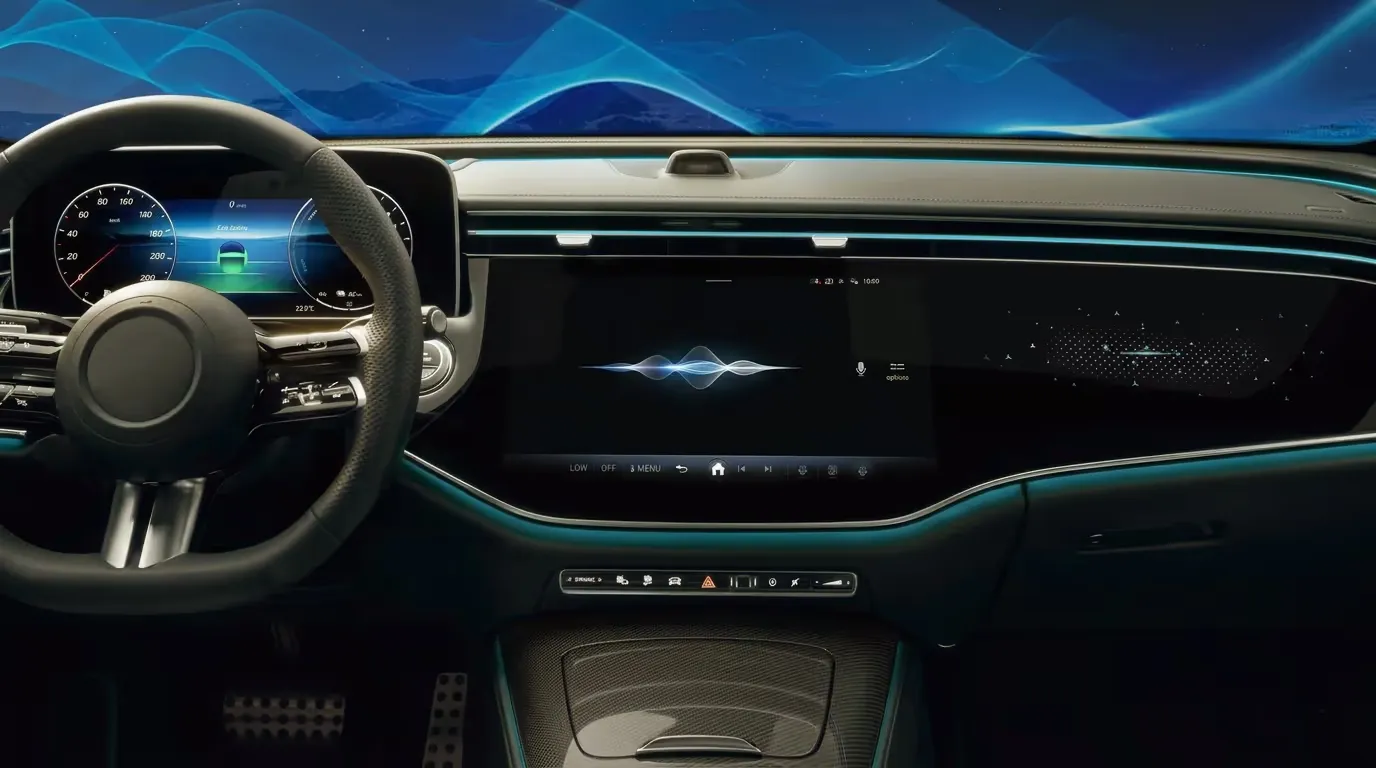
Voice AI · Automotive
Intelligent Voice AI for the Connected Car
From wake word detection and in-cabin noise suppression to on-device voice assistants and infotainment integration — Synervoz delivers production-ready voice AI built for the demands of the automotive environment.
Everything You Need for Voice AI in the Vehicle
Production-ready voice AI tools purpose-built for the acoustic challenges and real-time requirements of the in-cabin environment — from driver interaction to infotainment control.
Wake Word & Voice Trigger Detection
Always-on, low-power wake word detection that activates the voice assistant instantly — running entirely on-device, with no network dependency. Customizable trigger phrases for OEM or aftermarket branding.
In-Cabin Noise Suppression
Real-time acoustic echo cancellation (AEC), road noise reduction, and beamforming for multi-microphone arrays. Ensures clean voice capture even at highway speeds or with audio playback active.
On-Device Speech-to-Text & NLU
Automatic speech recognition (ASR) and natural language understanding that runs locally — no audio leaving the vehicle. Fast, private, and functional in areas without connectivity.
Voice-Controlled Infotainment
Natural language interfaces for navigation, media playback, climate control, and connected services. Works with Android Auto, CarPlay, and custom IVI platforms built on Linux or QNX.
Speaker Identification & Personalization
Identify individual occupants by voice to personalize settings, preferences, and media recommendations automatically — without requiring a login or button press.
Hybrid Cloud Orchestration
Coordinate on-device voice processing with cloud-based services for complex requests — keeping sensitive audio local while reaching cloud NLU or content APIs only when connected and appropriate.

Voice AI Across Every Automotive Context
From OEM in-cabin assistants to aftermarket infotainment and fleet telematics — Synervoz has the building blocks to match your deployment context.
OEM In-Cabin Voice Assistants
Custom voice AI for production vehicles — branded wake words, always-on microphone processing, and natural language control of vehicle systems with sub-50ms response times.
- Custom wake word training & deployment
- Multi-microphone array processing
- Integrates with vehicle domain controllers
Infotainment & Head Unit Apps
Build or modernize apps for Android Auto, CarPlay, and custom IVI head units. Synervoz bridges mobile audio stacks to in-vehicle platforms — including streaming, podcast, and entertainment apps.
- Android Auto & CarPlay adaptation
- Audio engine porting across platforms
- Voice-first UX for driver safety
Fleet & Commercial Vehicles
Voice interfaces for fleet management, driver coaching, and telematics — designed for noisy commercial environments and operable hands-free to keep drivers safe and compliant.
- Hands-free dispatch & navigation commands
- Driver monitoring & fatigue detection signals
- Edge inference for connectivity-limited routes
EV & Autonomous Vehicle Platforms
Voice AI for next-generation vehicle platforms — including cabin experience in autonomous vehicles where the driver may become a passenger, and energy-efficient audio processing for EV power budgets.
- Passenger-mode cabin voice experience
- Low-power audio pipeline for EV efficiency
- Prototype-to-production on Switchboard SDK
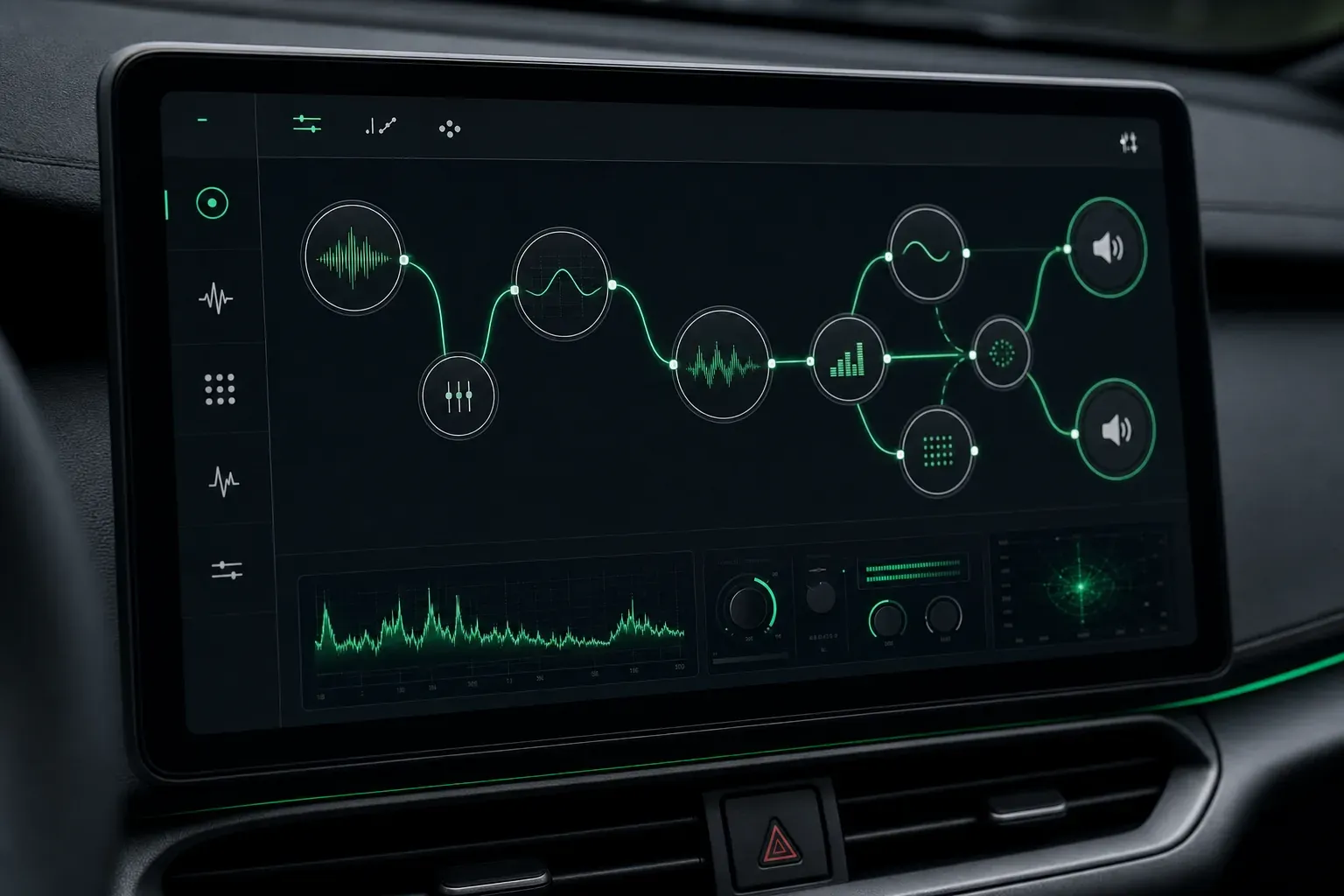
Switchboard: The Flexible Engine Behind Production Automotive Voice AI
Building voice AI for the vehicle means dealing with platform fragmentation, acoustic variability, and the need to swap models as the technology evolves. Switchboard is the infrastructure layer that makes this tractable.
-
Cross-platform from day one
A single C++ audio engine that targets iOS, Android, Linux, and embedded MCUs — deploy the same pipeline across head units, companion apps, and cloud.
-
Swap models without rebuilding
Replace the wake word engine, ASR model, or TTS synthesizer as better options emerge — without rewiring the rest of your audio pipeline.
-
Prototype fast, deploy with confidence
Switchboard Editor's no-code graph UI lets you wire up a voice pipeline in hours. Validate acoustic behavior, then deploy the same graph to production hardware.
-
On-device by design
Privacy-first architecture keeps voice data local. No audio transmitted unless you explicitly route it — compliant with automotive data regulation and OEM security requirements.
Voice AI That Works Without a Signal
Connectivity in a vehicle is intermittent. Synervoz builds voice AI that operates fully on-device by default — so the in-cabin experience works at highway speed in the middle of nowhere, not just in parking structures with good Wi-Fi.
-
Zero-Latency Wake Word
Always-on keyword detection with sub-50ms response — runs on the audio DSP or application processor, consuming minimal power even in sleep mode.
-
Multi-Mic AEC & Beamforming
Our C++ audio engine processes microphone arrays in real time — eliminating echo from speakers, attenuating road and wind noise, and focusing on the speaker's voice.
-
Offline-Capable ASR & NLU
Core speech recognition and command understanding run fully on-device using compact models optimized for automotive-grade SoCs — no network round-trip needed for most interactions.
-
Intelligent Cloud Fallback
When connectivity is available, Switchboard can route complex requests to cloud services — seamlessly, without changing the application interface above it.
-
Power-Optimized for EV & Embedded
Audio pipeline power profiling and DSP-offload strategies keep voice AI within automotive power budgets — critical for EV efficiency and always-on embedded deployments.
Audio Expertise Built for Automotive
Real-time audio and voice processing is the core of what we do — and we've been doing it for over a decade.
10+ Years of Audio R&D
Deep expertise in audio DSP, microphone array processing, and real-time voice systems — built from shipping production software across mobile, embedded, and connected device platforms.
Production-Ready Technology
Switchboard SDK is battle-tested infrastructure deployed in real products — not a research prototype. Your automotive deployment ships on proven technology.
Embedded & Edge-Native
Our C++ core runs on resource-constrained automotive SoCs — not just cloud servers. We understand power budgets, memory constraints, and real-time audio scheduling at the hardware level.
Model-Agnostic Architecture
We don't lock you into a specific ASR vendor or NLU provider. Switchboard's node-based design means you can swap models as the landscape evolves without rebuilding your stack.
Ecosystem Integration
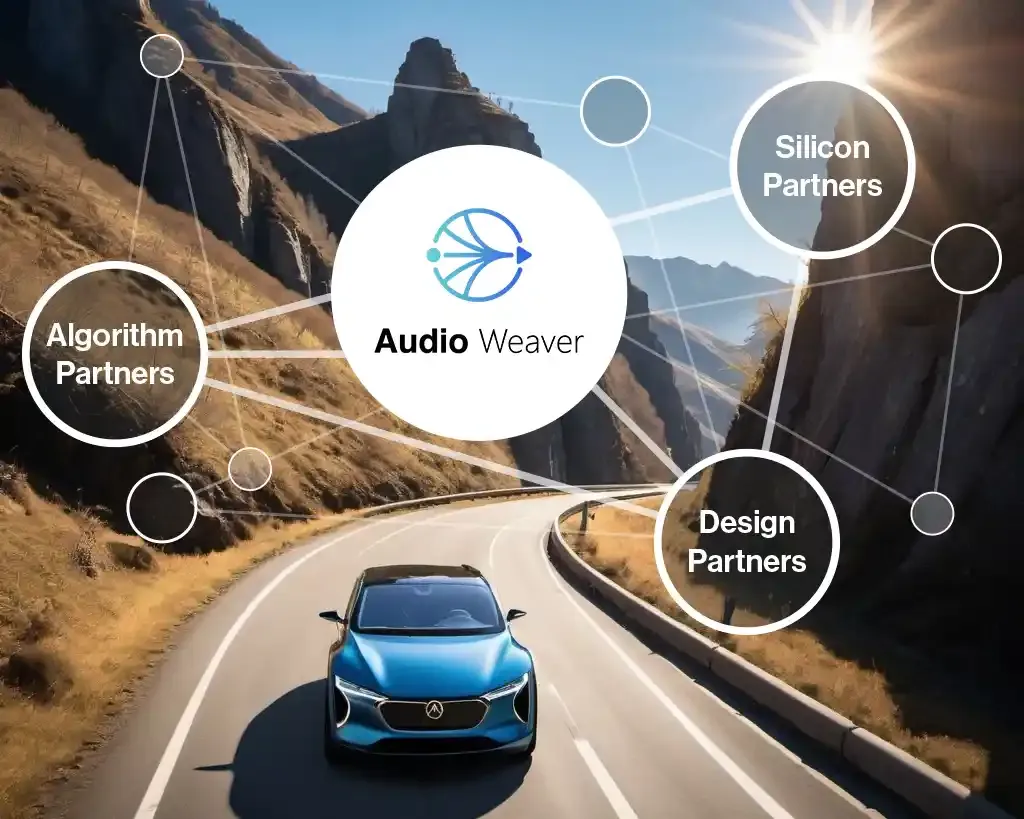
We can help integrate new functionality into your existing ecosystem. Whether you're working with DSP Concepts Audio Weaver, QNX Sound, or a custom stack, we can design integrations that fit your existing architecture.
From Prototype to Production
Switchboard Editor lets you validate a voice pipeline in days. We work with you from proof-of-concept through hardware integration and production certification — not just the demo.
Ready to bring voice AI into the vehicle?
Whether you're building an IVI app, integrating a custom voice assistant, or evaluating on-device audio AI for a next-generation platform — let's start with a technical conversation.