
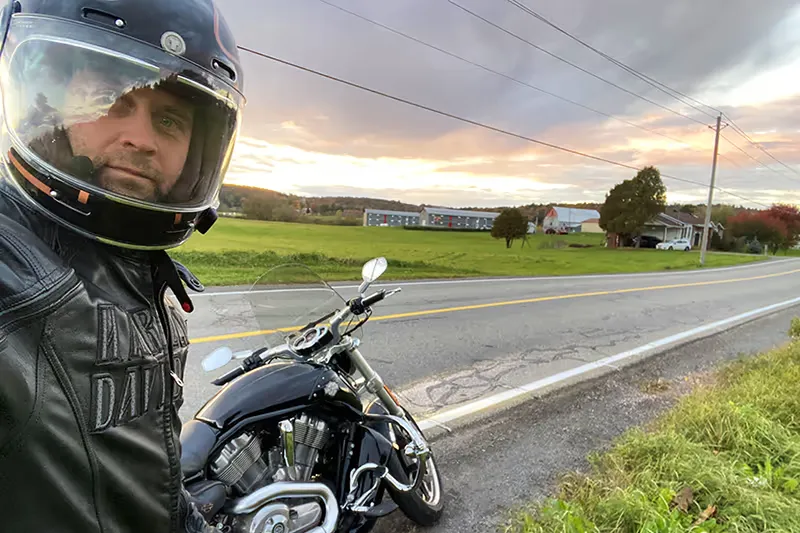
This is the first summer I've ridden with AirPods Pro 3.
Apple also recently released a beta firmware update for AirPods that adds some interesting new capabilities, so I wanted to do some testing.
What follows are some of my observations about this experience, as well as where I see the future of motorcycle audio given this experience and the gaps that remain to be filled.
This is not meant to be a review of any of the products mentioned here; just some personal observations and what I think they mean for where the industry is headed.
I’ve been chasing the "perfect motorcycle audio experience" for well over a decade. Not just as a rider, but professionally, given my company specializes in audio software development.
Over the last ten years of running Synervoz, I've had conversations with companies across the industry—Cardo, Sena, Apple (including the AirPods team), and others—about what I thought was missing from the motorcycle audio experience.
For years, it always felt like the technology was moving in the right direction, but painfully slowly. This week was the first time I got on my Harley and thought:
"Wait... this is actually starting to happen."
From the original AirPods Pro to AirPods Pro 3
I've been riding with AirPods under my helmet since the original Pro model first came out.
My original AirPods Pro worked pretty well initially – certainly better than any passive earplugs ever worked for me – but over time the active noise cancellation became less effective. They also developed that infamous high-pitched squeal every once in a while, which made rides less fun and more tiring.
So I bought a new pair of AIrPods Pro 3 and this summer is the first time I’ve gotten to try them out while riding. And the difference is even more than I expected.
Noise Suppression and Adaptive Audio
For context, I ride a Harley V-Rod Muscle. If you've never heard one in person, it isn't exactly a quiet motorcycle. It’s a Porsche-designed engine with a badass sound, but it also makes an absurd amount of noise.
I ride with a full-face helmet. Often without a windshield, and in that setup the engine remains louder than the wind until, I dunno, maybe 80-100 km/h. With a windshield, that crossover might happen closer to 120 km/h. Hard to say exactly, but historically that’s my perception using the original Airpods Pro.
But with my Airpods Pro 3, the engine noise drops from being the dominant thing you hear to barely noticeable. It’s almost weirdly quiet (more on safety concerns later). And it does a pretty good job of killing the wind at highway speeds as well.
But even more interesting was Adaptive Audio. You can actually hear the noise cancellation gradually engage, which really lets you appreciate just how much sound it's removing.
Paired with Conversation Awareness, it’s kind of a game changer.
I often find myself in a scenario where I pull into a gas station, or stop at a red light, friends roll up next to me, and start talking. So immediately I’m fumbling in my pocket trying to change the volume (among other alternatives like pausing music, finding transparency, etc.).
And by the time I've done all that, the light is green and I’m either fighting to pocket my phone or get the volume back up before moving again.
Of course, different solutions with voice detection and music auto-ducking have been in the market for a while. In fact, we patented some technology in this area almost 15 years ago. But incumbent alternatives had always been limited in other ways. For example, mobile apps (including one we made) that combine VoIP + Music won’t work off grid. And intercom systems historically do not have ANC (more on that later too).
So, having Adaptive Mode + Conversation Awareness built into the Airpods Pro 3 and that actually working in the vicinity of multiple Harley engines running is insane. The music fades smoothly and the transparency opens up so I can hear my friend, then the noise suppression ramps back up when we start moving again. It sounds almost magical.
Finally, we’re getting close.
What’s still missing
What's funny is that this is almost exactly the direction I've been hoping the industry would move toward. For years I've had conversations – though perhaps not enough – around the shortcomings of existing intercom systems. Not because they're bad. They're actually impressive pieces of engineering and product design. But they’ve never had it all, and a viable solution has always felt like cobbling together multiple components instead of one cohesive experience.
The Airpods Pro 3 experience shows me that the gap is narrowing. But there is still plenty of room to build a more cohesive system.
For example, Adaptive Audio could benefit from motorcycle-specific presets.
Imagine a mode that intentionally lets through:
emergency vehicle sirens
horns
tire squeal
nearby traffic
...while still aggressively suppressing engine and wind noise.
That's a very different optimization problem than walking around downtown wearing earbuds.
Voice control also still struggles.
At most meaningful speeds, Siri has a hard time hearing me at all.
And even in quiet conditions, she’s not great at changing directions or adding stops on the fly. She’s still a bit clunky vs. the ideal user experience one would hope for.
On the other hand, she’s WAY more capable than before. In quiet conditions, changing my music, pulling up Maps to go simply from point A to point B, or having a short voice AI conversation about whatever – it works.
It’s clear to me that the seamless voice experience where you can control multiple apps through a single unified interface – music, navigation, comms with friends, and random voice ai discussions – is almost here.
The biggest blocker at the moment is Siri’s inability to hear me at speed. That said, I don’t think it’s crazy to expect that, even under a full face helmet, and even at highway speed with crazy levels of noise, in-ear microphones could get a clean enough signal to work well in the context of voice commands and conversation in general – be it with other riders or Voice AI.
I’ve run a few experiments, and I intend to run several more (e.g. different helmets, different speeds, different bikes, different headphones), where I took recordings while riding.
What this shows is that, on that ride, I actually got a surprisingly good signal despite the noise and headphones being pressed into the foam of my helmet. And I’ve found my voice is usually intelligible across a variety of conditions. So, even if the current model wasn’t trained extensively in motorcycling conditions, if it’s intelligible to me, we can probably fine-tune a model to which it will also be intelligible.
It’s worth noting that motorcycle intercoms have the advantage of a directional microphone placed right in front of your mouth inside the helmet. On the other hand, they aren’t super portable. It would be nice if these were made wireless and sold with multiple fitments (velcro and otherwise) so that they could be easily swapped across different helmets, shared with friends, and potentially paired with either the intercom or your phone (for when you’re riding alone, or on-the-grid with friends who don’t have intercoms, for example).
A near term workaround I experimented with, using a cheap Bluetooth mic, worked surprisingly well. There's potentially an interesting accessory waiting to be built there.
But I digress.
Why Cardo and Sena Still Matter
It’s tempting to think AirPods will replace intercoms. But that’s still not feasible for off-grid rides.
One of the biggest advantages of Cardo and Sena is something your phone simply can't do.
Mesh intercom for rides where you have poor cellular coverage.
A consistent, reliable offline connection remains really valuable.
While Bluetooth offers some possible workarounds, there are serious limitations. The range isn't good enough, and for most in-market devices, as soon as you switch Bluetooth into two-way audio mode, your music is limited to a low sample rate, so it sounds terrible. While there are some other potential workarounds for devices – e.g. Bluetooth 5.3, aptX, Skaa for broadcast audio-sharing, among other possibilities – range will still be an issue for off-grid rides.
While I can imagine a purpose built device that you could put in your pocket for a more portable solution, helmet-mounted mesh intercoms are still the best solutions today.
Motorcycle Intercoms Have Their Own Problems
I've owned a Cardo Packtalk Bold for years.
It’s pretty good and accomplishes the essentials. And having tried out a newer model belonging to a friend of mine – intercoms seem to be getting a little better each year.
But they still leave a lot to be desired.
Installing speakers and wiring into a helmet is annoying.
They're not particularly portable if you own multiple helmets.
You can't easily lend one to a friend.
Voice commands become increasingly unreliable as speeds climb.
Depending on your helmet + intercom + mic setup, your motorcycle, and how much wind you're sitting in, the voice activity detection may not trigger unless you yell. Or it'll stay open when it shouldn't.
If you ride a Harley without a giant batwing fairing or if you don’t wear a full-face helmet, you'll struggle to find a setup that works.
And we still haven’t addressed active noise cancellation.
The Weird Hybrid Setup That Actually Works
So today I ride with a combination of my Cardo and AirPods Pro 3 inside my helmet. Surprisingly, it's a pretty good combination.
The AirPods handle music, Siri (which finally has some hope given recent changes), Google Maps, ANC, and Adaptive Audio.
The Cardo handles the intercom via mesh.
As long as I don't blast my music too loudly, I can still hear the intercom surprisingly well.
The two systems basically operate independently. It's not elegant, but it's the closest I've come to the experience I've wanted for years.
What About the New Sena + Bose Units?
I haven't yet had the chance to try the new Sena 60S EVO or 60X systems with Sound by Bose.
My guess is this will come closer than anything else to an all-in-one solution.
I'm definitely looking forward to trying it out to see how the in-helmet headphones sound, and curious to see how the system comes together with the optional ANC earbuds tied in.
I've heard the in-ear concerns over the years. Whether we’re talking about motorcycling, running, or cycling; that in-ear devices are too dangerous because they block important road sounds.
The concern is well founded. But I think the technology has finally moved beyond it. Selective hearing is now possible. Instead of simply blocking sound, we can choose which sounds matter. Suppress engine drone. Reduce wind fatigue. Boost sirens. Boost horns. Boost nearby traffic.
That isn't just more enjoyable. It could actually be safer.
The Last Mile
The thing that still feels missing isn't necessarily new hardware or entirely new software.
It's integration.
Imagine saying:
"Hey headset, mute the intercom for a minute."
Then continuing naturally:
"Find a place with a good patio where other bikers tend to stop."
"Reroute us through the twistiest roads."
“In my podcast they were talking about CRISPR GPT and AI-driven protein design. Can you give me an overview of how that works in layman terms?”
“Share the podcast with Nick and Greg and go back 2 minutes”
No memorizing command trees.
Seamlessly switching who and what you’re talking to, listening to, and paired with.
No confusion about whether you're talking to Siri, your headset, your phone, your GPS, or your intercom. The systems just integrate and interoperate seamlessly. Natural conversation to get what you want instantly and without memorizing what’s possible.
The underlying technology is finally capable. Voice AI has matured. Noise suppression has matured. Speech recognition has matured.
The missing piece is stitching everything together into one cohesive rider experience. None of these individual technologies feel futuristic anymore. The magic is making them disappear into the background. It’s easier said than done, but it’s exciting that we’re finally there.
Why I'm Optimistic
For the first time, I don't feel like we're waiting for some future breakthrough. I think we're mostly waiting for good product design. The building blocks are finally here.
As someone who's spent years building real-time voice systems at Synervoz, and who spends a lot of weekends riding, it's the most exciting time for motorcycle audio that I've seen in my riding lifetime.
I’ve long been thinking about that last mile.
More portable systems.
Better integration between music, intercoms and voice assistants.
Natural Voice AI conversations instead of rigid command phrases.
Smarter interaction with the next generation of Siri and other AI assistants.
The future motorcycle headset shouldn't feel like a collection of separate gadgets. It should feel like one intelligent companion riding with you. For the first time in a long time, I think we're actually close.
If you're working on this problem too, I'd love to talk.